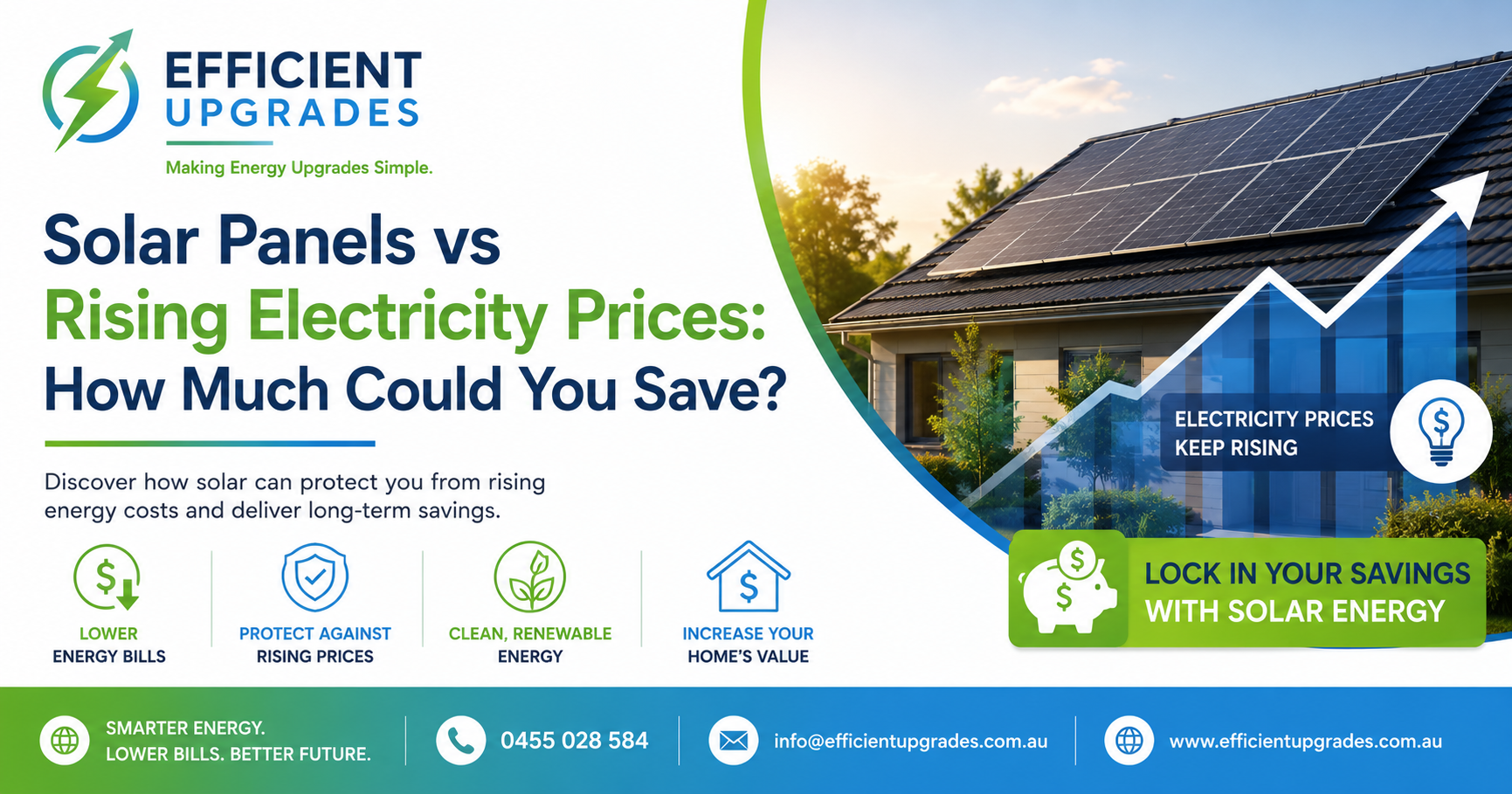
Electricity costs are an important consideration for Australian households, particularly as energy prices and household power consumption continue to change. For Victorian homeowners, solar panels can provide a practical way to generate renewable electricity at home and reduce the amount of energy purchased from the grid.
But how much can solar actually save you?
The answer depends on factors such as your electricity usage, solar system size, roof orientation, household habits, energy retailer, and how much of your solar power you use rather than export. In this guide, Efficient Upgrades explains how solar panels can help reduce electricity costs and why investing in solar may make sense for your home.
Why Are Homeowners Looking at Solar?
Traditional electricity plans leave households exposed to changes in electricity prices. When your home relies heavily on grid electricity, increases in energy rates can have a direct impact on your bills.
Solar panels provide an alternative by allowing you to generate electricity from sunlight.
Instead of purchasing all your electricity from the grid, you can use solar power generated on your own roof during the day.
This can help you:
- Reduce your electricity bills
- Increase your energy independence
- Use more renewable energy
- Reduce your reliance on the electricity grid
- Potentially protect your household from future energy price increases
How Do Solar Panels Reduce Electricity Bills?
Solar panels generate electricity during daylight hours. When your home is using appliances at the same time, that solar energy can be consumed directly.
For example, your solar system could help power:
- Air conditioning
- Refrigerators
- Washing machines
- Dishwashers
- Pool pumps
- Hot water systems
- Home office equipment
- Other household appliances
The more of your solar electricity you use directly, the less electricity you may need to purchase from the grid.
This is known as solar self-consumption.
Solar Self-Consumption Is the Key to Greater Savings
Installing solar panels does not automatically guarantee the same level of savings for every household.
Your savings are strongly influenced by when your home uses electricity.
A household that uses more electricity during the day may be able to consume a larger portion of its solar generation directly. If most of your electricity usage occurs at night, you may export more solar electricity during the day and purchase electricity from the grid later.
This is where smart energy management and battery storage can make a difference.
How Much Could You Save With Solar?
There is no single savings figure that applies to every Victorian home.
Your potential savings depend on several factors, including:
1. Your Electricity Usage
A home with higher electricity consumption may have greater potential to benefit from solar because there is more energy demand to offset.
2. Solar System Size
The size of your solar system affects how much electricity it can generate. A correctly sized system can help balance your home’s energy consumption and available roof space.
3. Roof Orientation and Shading
The amount of sunlight your panels receive affects their energy production. Roof direction, pitch, shading, trees and nearby buildings can all influence performance.
4. When You Use Electricity
Using appliances during periods of strong solar generation can increase self-consumption and potentially improve your savings.
5. Electricity Rates and Feed-in Tariffs
Your electricity retailer’s rates and the feed-in tariff available to you can also affect the overall financial benefit of installing solar.
Solar vs Rising Electricity Costs
One of the biggest advantages of solar is that it allows you to generate part of your electricity yourself.
Instead of purchasing every unit of electricity from the grid, your solar panels can supply a portion of your household’s energy requirements.
This means your solar system can continue providing value even as electricity costs change.
Solar does not completely eliminate electricity bills for every household, but it can significantly reduce the amount of grid electricity you need to purchase when the system is properly designed and used.
Can a Solar Battery Increase Your Savings?
For many homes, adding a battery can further improve solar self-consumption.
During the day, your solar panels may generate more electricity than your home needs. Rather than exporting all of that excess electricity, a battery can store some of it for later use.
You can then use stored energy when:
- The sun has gone down
- Solar generation is low
- Household electricity demand increases
- You want to reduce your reliance on grid electricity
A battery can be particularly useful for households that use most of their electricity in the evening.
However, battery suitability depends on your energy consumption, existing solar system, available space, budget and energy goals.
Solar Panels and Air Conditioning
Heating and cooling can represent a significant part of household electricity consumption.
Solar can help offset some of the electricity required to operate air conditioning during the day. This can be particularly useful during sunny summer periods when solar generation is often strong.
For homeowners considering several energy upgrades, combining solar with efficient air conditioning and other energy-efficient technologies can create a more comprehensive approach to reducing household energy costs.
Solar and Heat Pump Hot Water
Another way to increase solar self-consumption is to use solar electricity to operate an efficient heat pump hot water system.
With appropriate system settings and energy management, households may be able to use more of their own solar generation for hot water instead of relying as heavily on grid electricity.
This is one reason why looking at your home’s energy system as a whole can be more effective than considering individual upgrades separately.
Is Solar Still Worth It?
For many Victorian homeowners, solar remains an attractive long-term energy investment.
However, the right system should be based on your home’s actual electricity consumption rather than simply choosing the largest system available.
Before investing, consider:
- Your current electricity bills
- Daily and seasonal energy consumption
- Available roof space
- Roof orientation and shading
- Current electricity plan
- Expected household energy needs
- Whether you may add a battery later
- Available government incentives and rebates
A professional assessment can help determine an appropriate system size and expected energy performance.
How to Maximise Your Solar Savings
Once your solar system is installed, a few simple changes can help you make better use of the electricity it generates.
Run Appliances During the Day
Where practical, use high-energy appliances such as washing machines, dishwashers and pool pumps during periods of solar generation.
Monitor Your Energy Usage
Understanding when your home consumes electricity can help you identify opportunities to increase solar self-consumption.
Consider Battery Storage
If your household uses significant electricity after sunset, a battery may allow you to store excess solar energy for later use.
Choose Energy-Efficient Appliances
Efficient appliances require less electricity, helping you get more value from the energy your solar system produces.
Review Your Energy Plan
Your electricity retailer and energy plan can affect your overall savings. Regularly reviewing your plan can help ensure it remains suitable for your household.
Why Choose Efficient Upgrades?
At Efficient Upgrades, we make energy upgrades simple by helping Victorian homeowners find practical solutions for reducing energy costs and improving home efficiency.
Our energy solutions include:
- Solar Panels
- Solar Battery Systems
- Air Conditioning
- Heat Pump Hot Water Systems
- EV Chargers
We can help assess your home’s energy requirements and recommend an upgrade strategy based on your current usage, budget and future goals.
Contact Efficient Upgrades
Ready to explore how solar could reduce your home’s electricity costs?
Efficient Upgrades
📞 0455 028 584
📧 info@efficientupgrades.com.au
🌐 www.efficientupgrades.com.au
Making Energy Upgrades Simple.
Summary
Rising electricity costs can make household energy expenses difficult to predict. Solar panels give homeowners the opportunity to generate their own renewable electricity and reduce their reliance on the grid.
The amount you can save depends on your energy consumption, solar system size, household usage patterns, electricity rates and other factors. Increasing solar self-consumption through smart energy use, efficient appliances and potentially battery storage can help maximise the value of your system.
For Victorian homeowners considering solar, the best starting point is a professionally designed system that matches your home’s energy requirements.
Efficient Upgrades can help you explore your solar options and take the next step towards smarter energy, lower bills and a more sustainable home.
Frequently Asked Questions
How much can solar panels reduce my electricity bill?
Savings vary between homes. Your potential savings depend on your electricity consumption, solar system size, solar generation, self-consumption and electricity rates.
Do solar panels protect against rising electricity prices?
Solar cannot completely protect a household from electricity price changes, but generating your own electricity can reduce the amount of power you need to purchase from the grid.
Is a solar battery necessary?
Not every home needs a battery. A battery can be particularly useful when a household has significant evening electricity consumption and wants to store excess daytime solar energy.
Can I add a battery to my existing solar system?
In many cases, a battery can be added to an existing solar installation. System compatibility and the existing inverter configuration should be assessed before installation.
How can I get more savings from my solar panels?
Using appliances during solar-generation hours, monitoring your energy consumption, choosing efficient appliances and considering battery storage can all help increase solar self-consumption.
Does Efficient Upgrades install solar panels in Victoria?
Efficient Upgrades provides solar and energy upgrade solutions for Victorian homeowners. Contact the team to discuss your home’s requirements and available options.