Keeping every room in your home comfortable doesn’t mean you need to heat or cool every room at the same time.
For many Melbourne homeowners, ducted air conditioning with zoning can provide a smarter way to manage indoor comfort. Instead of running the system throughout the entire house, zoning allows different areas to be controlled according to how and when they are being used.
This can improve comfort while helping avoid unnecessary energy use.
At Efficient Upgrades, we help Victorian homeowners explore ducted air conditioning solutions designed around their home’s layout, lifestyle and energy requirements.
What Is Zoning in Ducted Air Conditioning?
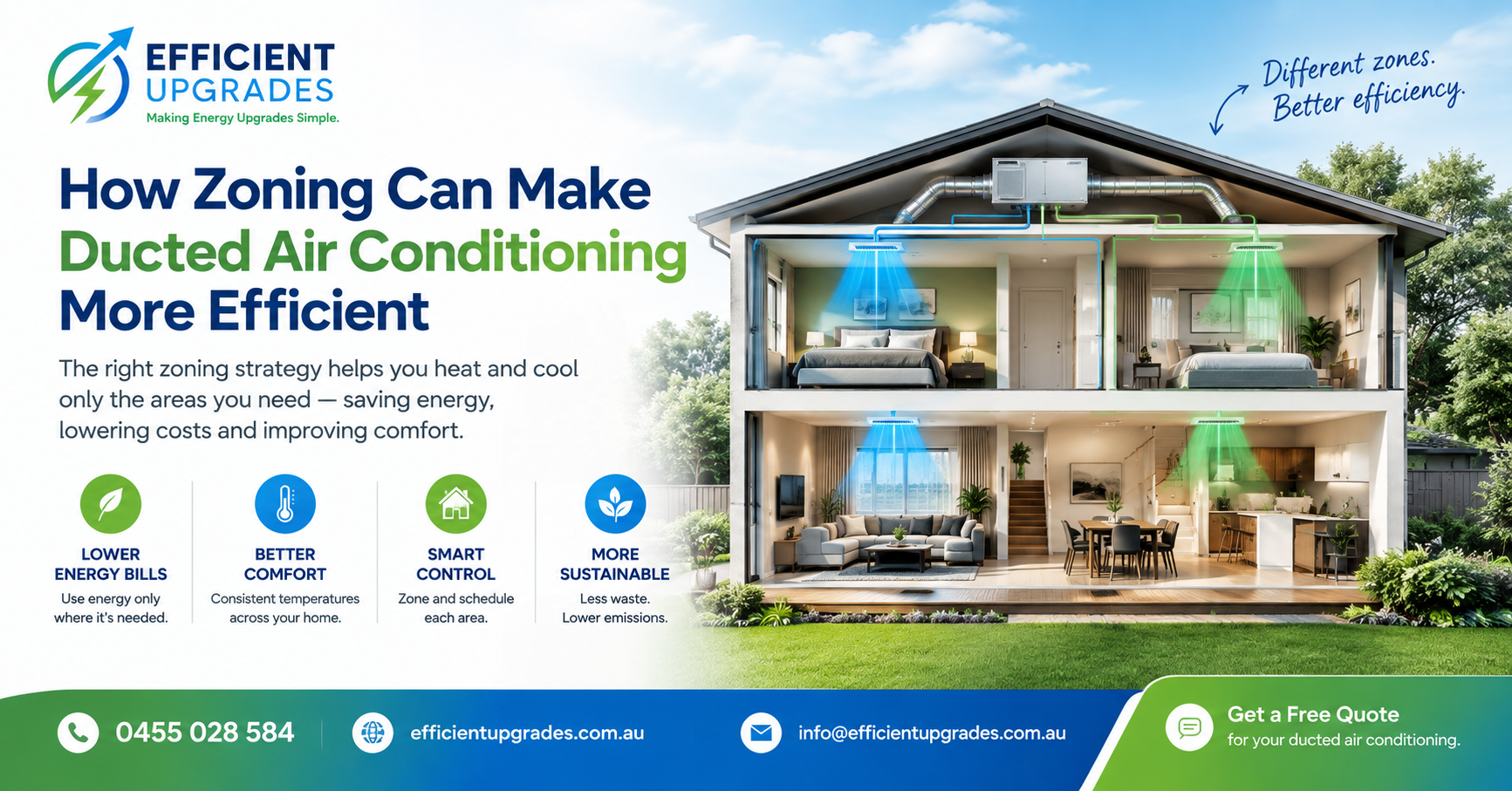
Zoning divides your home into separate areas, or zones, that can be controlled independently.
For example, a home could have:
- Zone 1: Living and kitchen areas
- Zone 2: Bedrooms
- Zone 3: Upstairs
- Zone 4: Downstairs
- Zone 5: Home office or study
Rather than conditioning the entire property, you can choose which zones require heating or cooling.
This is particularly useful for larger and double-storey homes where different areas may be occupied at different times.
How Does Zoning Improve Efficiency?
A conventional ducted system may distribute conditioned air throughout multiple rooms.
With zoning, you have greater control over where that conditioned air goes.
For example, if your family spends most of the evening in the living room and kitchen, you may not need to condition unused bedrooms at the same time.
By directing heating or cooling towards occupied areas, zoning can help reduce unnecessary energy use.
The basic idea is simple:
Use energy where you need it — rather than conditioning the whole house unnecessarily.
5 Benefits of Zoning Your Ducted Air Conditioning
1. Control Different Areas Independently
Different parts of your home can have different comfort requirements.
Bedrooms may need cooling at night, while living areas may be more important during the day.
Zoning allows you to manage these areas separately.
2. Potentially Reduce Energy Consumption
Heating or cooling an unoccupied room uses energy without providing much practical benefit.
With zoning, you can turn off or reduce conditioning in areas that aren’t being used.
This can help make your air conditioning system more efficient, although actual energy savings depend on the system, home design, settings and usage.
3. Improve Comfort Throughout the Home
Temperature preferences can vary between rooms and family members.
One person may prefer a cooler bedroom, while another may prefer a warmer living area.
Zoning provides greater flexibility in managing comfort across different areas of your home.
4. Ideal for Double-Storey Homes
Two-storey properties can experience noticeable temperature differences between floors.
Upstairs rooms can become warmer during summer, while downstairs areas may feel different.
Creating separate upstairs and downstairs zones can give homeowners greater control over these different areas.
5. Match Air Conditioning to Your Daily Routine
Your home’s energy requirements change throughout the day.
For example:
Morning:
Bedrooms and living areas may be used.
Daytime:
The home office or living areas may require conditioning.
Evening:
The kitchen, dining and living areas may become the main occupied zones.
Night:
Bedrooms may become the priority.
Zoning allows your air conditioning use to better match your family’s routine.
Zoning and Energy Efficiency: What You Need to Know
Zoning can help improve energy management, but simply having multiple zones doesn’t automatically guarantee lower electricity bills.
The results depend on several factors, including:
- Air conditioner efficiency
- System size
- Home insulation
- Outdoor temperature
- Number of zones
- Zone settings
- Operating hours
- Ductwork design
- How the system is used
A correctly designed system is therefore important.
Why Correct System Design Matters
The efficiency of a ducted air conditioning system isn’t determined by the indoor unit alone.
The entire system needs to work together.
This includes:
System Capacity
The air conditioner should be appropriately sized for the property’s heating and cooling requirements.
Ductwork
Ducts should be appropriately designed and insulated to help maintain efficient airflow.
Zone Design
Zones should reflect how the home’s rooms are actually used.
Airflow
Each zone needs appropriate airflow for effective heating and cooling.
Controls
The zoning controls should be easy to operate and suited to the household’s routine.
Can Zoning Work With a Double-Storey Home?
Yes. Zoning can be particularly useful in double-storey properties.
A practical configuration could divide the home into:
Upstairs Zone
Bedrooms and upstairs living areas.
Downstairs Zone
Kitchen, dining and living areas.
Additional zones can be created depending on the home’s size, layout and requirements.
This allows homeowners to condition different areas according to occupancy and time of day.
Smart Controls Make Zoning Easier
Modern ducted systems can offer advanced control options depending on the model.
Smart controls may allow homeowners to:
- Select zones
- Adjust temperatures
- Set schedules
- Control the system remotely
- Manage heating and cooling according to daily routines
For busy households, scheduling can make it easier to avoid running air conditioning when nobody is home.
Other Ways to Improve Ducted Air Conditioning Efficiency
Zoning is only one part of an efficient heating and cooling strategy.
Homeowners can also consider:
Improve Insulation
Good insulation helps reduce heat transfer through ceilings and walls.
Keep Filters Clean
Dirty filters can restrict airflow and affect system performance.
Maintain the Outdoor Unit
Keep the outdoor unit clear of leaves, debris and other obstructions.
Use Appropriate Temperature Settings
Avoid unnecessarily extreme heating or cooling settings.
Service the System
Regular professional maintenance can help identify issues affecting performance.
Seal the Home
Reducing unwanted air leakage can help your heating and cooling system work more effectively.
Is Zoned Ducted Air Conditioning Right for Your Home?
Zoning can be particularly useful if:
- You have a large home
- You have multiple floors
- Different rooms are occupied at different times
- Your family has different comfort preferences
- You want greater control over energy use
- You regularly leave parts of your home unoccupied
A professional assessment can help determine whether zoning is appropriate for your property’s layout and lifestyle.
Why Choose Efficient Upgrades?
At Efficient Upgrades, we help Victorian homeowners explore energy-efficient solutions designed around their homes.
Our services include:
- Ducted air conditioning
- Split-system air conditioning
- Solar panels
- Solar battery systems
- Heat pump hot water systems
We focus on understanding your home’s requirements before recommending a suitable solution.
From system selection to installation, our goal is to make energy upgrades straightforward.
Making Energy Upgrades Simple.
Frequently Asked Questions
What is zoning in ducted air conditioning?
Zoning divides a home into separate areas that can be controlled independently, allowing homeowners to heat or cool selected parts of the property.
Does zoning reduce electricity bills?
Zoning can potentially reduce energy consumption by allowing you to avoid conditioning unoccupied areas. Actual savings depend on the system, home, settings and usage.
Is zoning useful for double-storey homes?
Yes. Separate upstairs and downstairs zones can provide greater control where different floors have different temperature requirements.
Can I turn individual rooms off?
Depending on the system and zoning configuration, selected areas can often be turned down or off while other zones continue operating.
Does zoning improve comfort?
It can provide greater control over different areas of the home, helping homeowners match heating and cooling to their preferences and occupancy.
Can existing ducted air conditioning be zoned?
In some cases, an existing system can be modified to incorporate zoning. The feasibility depends on the existing equipment, ductwork and controls.
What else can improve ducted air conditioning efficiency?
Insulation, appropriate system sizing, efficient operation, clean filters, good ductwork and regular maintenance can all contribute to better system performance.
Summary
Zoning can make ducted air conditioning smarter and more flexible by allowing homeowners to heat or cool the areas they actually use.
For Melbourne homes, particularly larger or double-storey properties, zoning can help:
- Improve comfort
- Reduce unnecessary conditioning
- Better match energy use to occupancy
- Provide greater temperature control
- Support more efficient air conditioning operation
However, zoning works best when it is combined with correct system sizing, good ductwork, appropriate controls and an energy-efficient home.
At Efficient Upgrades, we can help you explore ducted air conditioning and other energy upgrades designed around your home’s needs.
Contact Efficient Upgrades
Ready to make your home more comfortable and energy efficient?
📞 0455 028 584
📧 info@efficientupgrades.com.au
🌐 efficientupgrades.com.au
Efficient Upgrades
Making Energy Upgrades Simple.