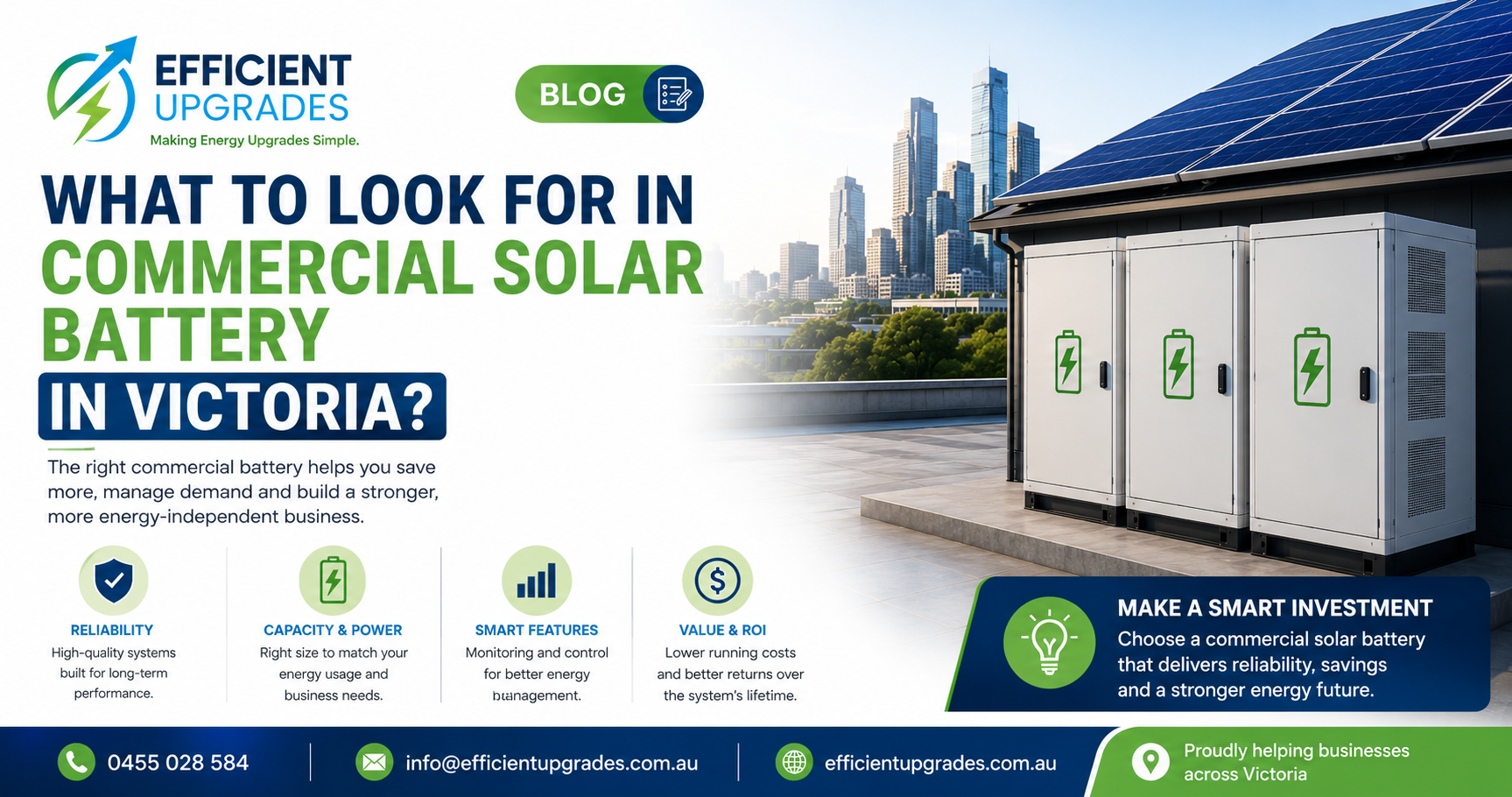
For Australian businesses, energy costs can have a significant impact on overall operating expenses. A Commercial Solar Battery in Victoria can help businesses make better use of solar energy, manage periods of high electricity demand and improve control over their energy supply.
Battery storage can also support business resilience and, where the system and program requirements allow, provide opportunities to participate in energy-management programs such as Virtual Power Plants (VPPs).
However, commercial battery storage is not a one-size-fits-all solution. The right system depends on your business’s electricity usage, solar generation, tariffs, operating hours, site conditions and long-term goals.
At Efficient Upgrades, we help businesses assess the practical factors involved in choosing a commercial solar battery.
What Should You Look for in a Commercial Solar Battery in Victoria ?
Before choosing a battery, it is important to understand what you want the system to achieve.
1. Start With Your Business Energy Goals
The first step is to define why you are considering battery storage.
Your business may want to:
- Reduce peak demand and associated charges
- Store excess solar energy for later use
- Reduce electricity purchased from the grid
- Provide backup power for critical operations
- Improve solar self-consumption
- Participate in VPP or demand-response programs
- Shift energy use away from expensive tariff periods
Your objective will influence the battery’s capacity, power output, controls and operating strategy.
For example, a system designed primarily for peak-demand management may require strong power output, while a system focused on energy shifting may place greater emphasis on usable storage capacity.
2. Look at Usable Battery Capacity
Battery capacity is generally measured in kilowatt-hours (kWh).
However, businesses should look beyond the headline or nameplate capacity and ask about usable capacity.
Usable capacity refers to the amount of energy that can actually be used within the manufacturer’s operating limits.
This is especially important when comparing different battery systems.
Consider:
- Usable kWh
- Depth of discharge
- Battery degradation
- Modular design
- Expansion options
A modular system can also be useful if your business expects its energy requirements to increase in the future.
3. Check the Battery’s Power Rating
Battery capacity and power output are two different things.
kWh tells you how much energy the battery can store.
kW tells you how quickly it can deliver that energy.
Commercial businesses can have high short-term electricity requirements from equipment such as:
- HVAC systems
- Refrigeration
- Pumps
- Motors
- Manufacturing equipment
- EV chargers
Make sure the battery’s continuous and peak power ratings are appropriate for your business’s requirements.
It is also worth checking the battery’s C-rate, which indicates how quickly the battery can charge or discharge relative to its capacity.
4. Consider Battery Chemistry and Safety
Battery chemistry can affect performance, lifespan, safety and overall system design.
Lithium Iron Phosphate (LFP or LiFePO₄) chemistry is widely used in fixed energy-storage applications because of its thermal stability and long cycle-life characteristics.
When comparing commercial batteries, don’t focus only on chemistry. Also look at the complete safety system.
Important features can include:
- Battery Management System (BMS)
- Thermal management
- Temperature monitoring
- Fault detection
- Safety controls
- Appropriate fire protection and mitigation measures
A commercial battery should be selected with the property’s installation requirements and safety considerations in mind.
5. Compare Round-Trip Efficiency
Not all of the electricity sent into a battery is available again for use.
Round-trip efficiency (RTE) measures the amount of energy recovered after charging and discharging.
Higher efficiency generally means less energy is lost during the storage process.
When comparing commercial battery proposals, ask suppliers to clearly state the expected round-trip efficiency and the conditions under which that figure applies.
6. Understand AC-Coupled vs DC-Coupled Systems
The way a battery connects to a solar system can affect system design.
DC-Coupled
A DC-coupled system connects the battery on the DC side of the solar system.
This can be advantageous in some new solar-and-storage installations by reducing certain conversion steps.
AC-Coupled
An AC-coupled system connects through the AC side of the system.
This can provide flexibility, particularly when adding battery storage to an existing solar installation.
The most appropriate configuration depends on the existing solar system, site requirements and overall system design.
7. Read the Warranty Carefully
A battery warranty is an important part of the commercial investment.
Don’t simply look at the number of warranty years.
Check:
- Warranty duration
- Throughput limits
- Guaranteed capacity at the end of the warranty
- Battery component coverage
- Inverter coverage
- Performance guarantees
- Availability or operating guarantees
- Warranty conditions
Some warranties include both a calendar period and a throughput limit, so understanding the full terms is essential.
A clear warranty from an established manufacturer can provide greater confidence in the long-term investment.
8. Consider the Energy Management System
A commercial battery is more than the battery hardware itself.
The control system can determine how effectively the battery responds to your business’s energy requirements.
Look for an appropriate Energy Management System (EMS) capable of supporting functions such as:
- Peak-demand management
- Solar self-consumption
- Time-of-use optimisation
- Battery scheduling
- Backup priorities
- Energy monitoring
- Demand response
If your business is considering VPP or other energy-market participation, check whether the system’s software and communications capabilities are compatible with the relevant program.
9. Check Australian Compliance and Approvals
Commercial battery installations need to meet relevant Australian requirements and applicable electrical and safety standards.
Depending on the project, considerations can include:
- Electrical requirements
- Grid connection requirements
- Inverter compatibility
- Protection systems
- Fire safety
- Building requirements
- Installation location
- Local approvals
Rules and connection requirements can vary depending on the project and network.
Working with an experienced commercial installer can help ensure the proposed system is designed and installed appropriately.
10. Look for Strong Local Support
A commercial battery is a long-term business investment.
If something goes wrong, access to technical support and service can be extremely important.
When comparing suppliers, consider:
- Australian technical support
- Authorised installers
- Local service capability
- Spare-parts availability
- Firmware support
- Maintenance arrangements
- Response times for faults
A lower initial price may not provide the best value if ongoing service and support are difficult to access.
11. Research Reliability and Safety History
Before selecting a particular battery model, research its history.
Look for information about:
- Product recalls
- Safety incidents
- Manufacturer updates
- Software restrictions
- Warranty issues
- Reported performance concerns
Ask the supplier whether the proposed system has experienced any significant issues and, if so, how they were addressed.
Transparency is an important part of choosing a long-term commercial energy-storage solution.
12. Calculate Total Cost of Ownership
The cheapest battery isn’t necessarily the best commercial investment.
Instead of comparing only the upfront purchase price, consider the total cost of ownership (TCO).
This can include:
- Battery equipment
- Inverter and control equipment
- Installation
- Electrical works
- Civil works
- Grid connection costs
- Maintenance
- Replacement components
- Financing costs
- Expected degradation
- Potential energy savings
- Demand-cost reductions
- Potential revenue from eligible energy programs
Ask for a financial model that shows expected savings and payback under realistic assumptions.
It can also be useful to compare proposals from multiple experienced providers.
13. Think About Future Expansion
Your business’s electricity requirements may change over time.
A battery system that works today may need to support additional energy demand in the future.
Look for systems that offer:
- Modular capacity
- Expandable battery racks
- Flexible power configurations
- Software updates
- Compatible energy-management platforms
- Integration options
A scalable system can make future expansion easier if your business grows or electricity demand increases.
14. Assess the Installation Site
Commercial batteries require suitable physical and electrical conditions.
Before installation, consider:
Space
There must be sufficient room for the battery system and required equipment.
Ventilation and Thermal Management
Battery systems need appropriate temperature management and ventilation where required.
Electrical Infrastructure
Switchgear, cabling, protection equipment and connection arrangements must be appropriately designed.
Maintenance Access
Technicians need safe access to inspect and service the system.
Fire Safety
The installation must consider relevant fire-safety requirements and appropriate separation and protection measures.
A site-specific assessment is essential before finalising a commercial battery design.
15. Explore Financing and Energy Programs
The upfront cost of a commercial battery can be significant, so businesses may wish to investigate different purchasing and financing options.
Depending on eligibility and availability, businesses may consider:
- Equipment finance
- Installer financing
- Leasing arrangements
- Available government incentives
- Demand-response programs
- VPP participation
- Other energy-management programs
Always review the terms carefully, particularly where a third party controls the battery or shares revenue from energy-market participation.
16. Choose the Right System Size Commercial Solar Battery in Victoria
Commercial battery projects can range from relatively small systems for light-commercial properties to large-scale installations with hundreds or thousands of kWh of storage.
The appropriate size depends on your objectives.
Smaller Commercial Systems
May suit businesses with moderate energy consumption and smaller solar installations.
Larger Commercial Systems
May be appropriate for businesses with substantial electricity demand, significant solar generation or more complex energy-management requirements.
Large-Scale Systems
Larger projects may require specialised engineering, grid studies, connection approvals and experienced project developers.
The goal shouldn’t simply be to install the largest battery possible. It should be to install a system that matches your energy profile and business objectives.
17. Monitoring and Data Matter
A commercial battery should provide useful information about its operation.
Good monitoring can help businesses track:
- Battery state of charge
- Solar generation
- Energy consumption
- Battery charging and discharging
- Grid imports and exports
- System performance
- Faults and alerts
Access to historical data can also help businesses measure performance, identify issues and evaluate whether the system is delivering the expected results.
Commercial Solar Battery in Victoria Procurement Checklist
Before signing a commercial battery proposal, ask:
System
- What is the usable battery capacity?
- What is the continuous power rating?
- What is the peak power rating?
- Is the system modular?
- Can it be expanded?
Performance
- What is the round-trip efficiency?
- What is the expected degradation?
- What is the expected operating life?
Safety
- What battery chemistry is used?
- What BMS and thermal-management systems are included?
- What safety certifications and protections apply?
Warranty
- How long is the warranty?
- Is there a throughput limit?
- What capacity is guaranteed at the end of the warranty?
- What components are covered?
Software
- Does the system include an EMS?
- Can it perform peak-demand management?
- Does it support energy monitoring?
- Can it integrate with relevant third-party platforms?
Installation
- What site works are required?
- What electrical upgrades are needed?
- Who handles approvals and grid connection?
- What maintenance access is required?
Commercial
- What is the total installed cost?
- What are the expected savings?
- What is the estimated payback?
- What ongoing maintenance costs should be expected?
Why Choose Efficient Upgrades?
At Efficient Upgrades, we understand that commercial energy storage is a significant investment.
Our focus is on helping Australian businesses explore practical energy solutions based on their property, electricity consumption and long-term goals.
Our services include:
- Commercial solar systems
- Commercial battery storage
- Solar and battery integration
- Energy-efficient upgrades
- Energy management solutions
We aim to make the process straightforward—from understanding your energy requirements to exploring suitable system options.
Making Energy Upgrades Simple.
Frequently Asked Questions Commercial Solar Battery in Victoria
What size commercial solar battery do I need?
There is no universal battery size. The right capacity depends on your electricity consumption, solar generation, operating hours, peak demand and the purpose of the battery.
Is LFP a good battery chemistry for commercial storage?
LFP is widely used for stationary energy storage because of its thermal stability and cycle-life characteristics. However, the complete battery system, safety controls, warranty and installation requirements should also be considered.
What is more important: battery kWh or kW?
Both are important. kWh indicates how much energy the battery can store, while kW indicates how quickly it can deliver that energy. Your business requirements determine the appropriate balance.
Can a commercial battery reduce peak demand costs?
A suitably configured battery may help manage periods of high electricity demand. The potential benefit depends on your tariff, demand profile and battery control strategy.
Can I add a battery to my existing commercial solar system?
In many cases, battery storage can be integrated with an existing solar installation. The appropriate configuration depends on the existing equipment and site’s electrical requirements.
Can commercial batteries provide backup power?
Some systems can provide backup power when specifically designed and configured for this purpose. Backup requirements should be discussed during system design.
How long does a commercial battery last?
Battery lifespan varies depending on the technology, operating conditions, usage and warranty terms. When comparing systems, look at both expected cycle life and the manufacturer’s capacity guarantee.
Can a commercial battery participate in a VPP?
Some battery systems can participate in VPP or other energy programs when the equipment, software, aggregator and business are eligible. Program availability and requirements vary.
Summary
Choosing a Commercial Solar Battery in Victoria requires more than comparing battery prices or storage capacity.
Businesses should consider:
- Usable capacity and power output
- Battery chemistry and safety
- Round-trip efficiency
- Warranty and degradation
- Energy management capabilities
- Australian compliance
- Local service and support
- Total cost of ownership
- Future scalability
- Site requirements
- Monitoring and reporting
- Financing and energy-program opportunities
The best commercial battery is the one that matches your business’s actual energy requirements and long-term objectives.
With careful planning and professional system design, battery storage can become an important part of a business’s strategy for better energy management, greater solar utilisation and improved energy independence.
Contact Efficient Upgrades Commercial Solar Battery in Victoria
Ready to explore commercial solar and battery storage for your business?
📞 0455 028 584
📧 info@efficientupgrades.com.au
🌐 efficientupgrades.com.au
Efficient Upgrades
Making Energy Upgrades Simple.